We asked teens how to exercise better judgement online. Their responses blew us away.
“How might we improve people’s judgement in digital spaces?”
This was the question that guided the Untagle the Web hackathon, a two-day event we hosted this summer in collaboration with DoSomething.org. We gathered 15 exceptional young people who had expressed an interest in improving online life and asked them to develop a wireframe for a tool that would do just that.
Untangling the web
Last year, we partnered with DoSomething to develop Untangle the Web, a campaign designed to kickstart intergenerational conversations about digital life. DoSomething asked young people to take a quiz about how they used technology and media. Based on their responses, they received a digital personality and an action guide to help them start a conversation with an adult in their life. Whether a News Detective battling misinformation or a Ray of Sunshine spreading positive vibes, each young person shared an insight about their relationship with technology with a trusted adult.
Through this campaign, we aimed to reach 25,000 young people. Fifty-five thousand took the quiz.
Clearly, this project struck a chord with youth. We saw that young people recognized the effects that technology had on their lives and were desperate for resources that would help them navigate online environments.
Building on this momentum, we identified a small subset of the most engaged teens and asked them to apply for a hackathon—a two-day event where they could actually design a product that would help their peers untangle the web. We selected 15 of the most promising applicants from around the country and flew them out to New York City to participate.
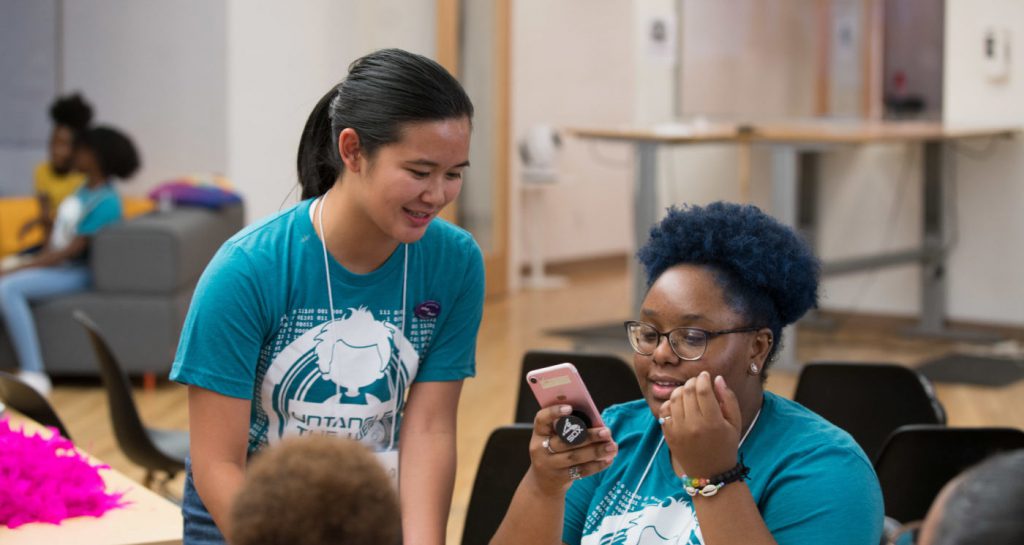
Designing a mobile application to improve judgement in digital spaces. © DoSomething.org
The Hackathon
Working in small groups under the guidance of DoSomething mentors, these 15 teens developed wireframes for products that addressed our challenge question: “How might we improve people’s judgement in digital spaces?” They then presented their ideas to a panel of judges with diverse experiences in technology:
- Samarth Bhaskar, Senior Editor for Digital Transition Strategy, the New York Times
- Ross Dakin, adjunct professor of computer science, Lehman College
- Tej Gokhale, Civic Action Lead, DoSomething.org
- Jerelyn Rodriguez, co-founder, The Knowledge House
- Calvin Stalvig, Director of Youth Programming, Beam Center
We wanted to make sure our participants had plenty of space to develop their own ideas, so we only had a few requirements. Products had to be feasible, with a well-articulated problem, simple solution, and clear distinction from applications already on the market. They had to be functional, with a fleshed-out user experience. Lastly, they had to be integrated with existing online platforms.
Working in teams of three, our participants developed five product ideas:
- Thinklight: a chatroom that connects users with mental health professionals.
- ZiN: a bot that sends users daily affirmations that reinforce positive behaviors.
- VeriLegit: an application that uses existing databases to judge the accuracy of online media.
- HideOut: a service that clarifies who will see the personal information that users share.
- BullyBeeGone: a program that automatically hides and deletes abusive comments and messages on social media.
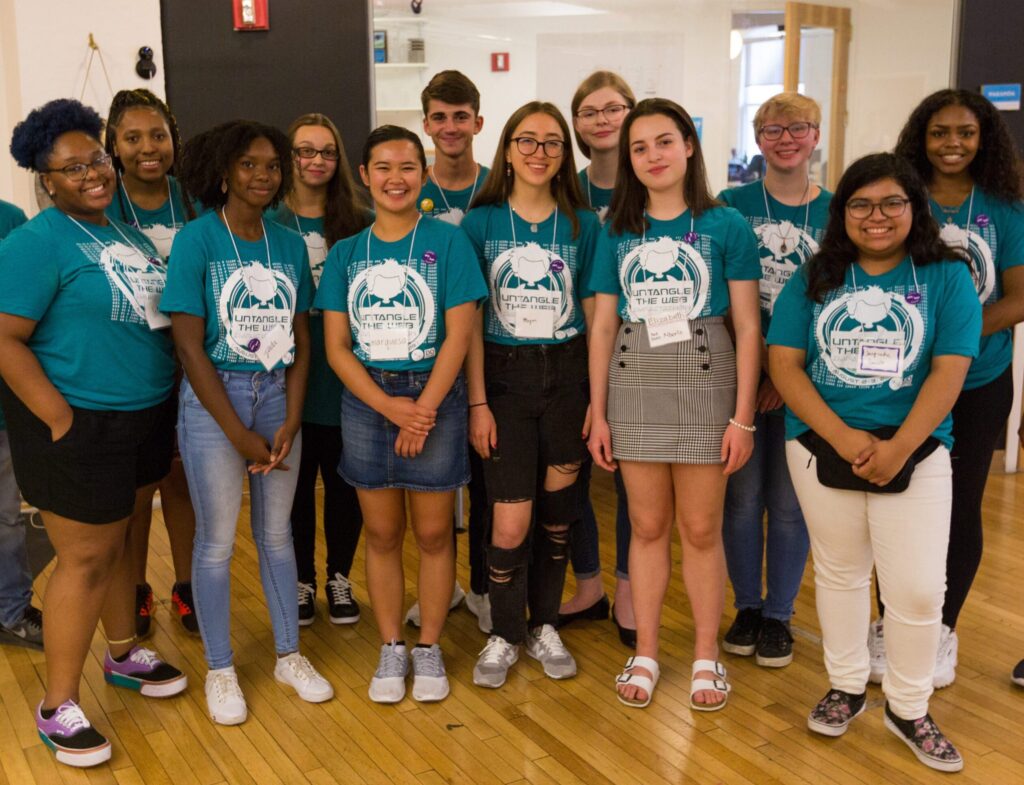
The 15 participants. © DoSomething.org
What did we learn?
This inspiring group of youth taught us so much about how young people today relate to technology. Here are our main takeaways.
- Young people want their voices to be heard. Over and over again, the young participants expressed appreciation that adults were making space for their ideas—and their leadership. Knowing that their voices are truly valued can encourage young people to get involved.
- These issues resonate with participants. The 15 young people we invited to the hackathon care deeply about online interaction. They also believe that online spaces could function better for young people—and that they’re perfectly capable of fixing them. These people were willing to spend a summer weekend working hard to make the internet better. They skipped their optional breaks to do it. And they designed five really, really impressive products.
- Diverse solutions empower more users. In the selection process, we prioritized participants that came from different geographies, races, socioeconomic backgrounds, and gender and sexual identities. This group clearly recognized that issues of online judgement don’t operate in a vacuum, and proposed solutions that took identity into consideration.
- Good online judgement means something different to everyone. We encouraged our participants to relate this topic to their own lived experiences. This allowed the cohort to focus on the specific issue or multiple issues that they felt were most pressing—and led to a diverse set of solutions. These participants didn’t necessarily agree on a single definition of “online judgement.” We think that’s a good thing. The one thing our participants did agree on? That it shouldn’t just be on them to exercise good judgement—tech companies have a responsibility to promote it.
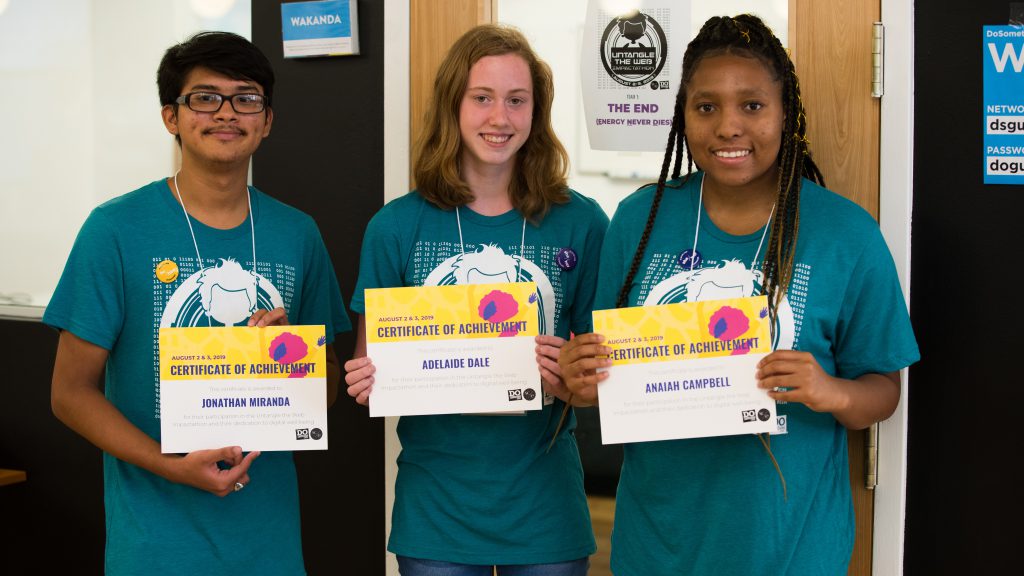
The BullyBeeGone team. © DoSomething.org
What comes next?
Based on a set of criteria that included functionality, user experience, and potential for impact, our panel of judges selected BullyBeeGone as the official winner of the hackathon. Over the next few months, DoSomething will work with BullyBeeGone’s young designers to develop a minimum viable product (MVP) that will bring this great idea one step closer to the market. We’re excited by BullyBeeGone’s potential and thrilled that young people themselves are involved at every step of the design process.
Young people have really good ideas—and they’re willing to share them. It’s up to us to listen and to help them bring those ideas to fruition. In partnership with organizations like DoSomething, we’re striving to elevate youth voice and unlock young people’s potential as true agents of change.
Two New Grants Take SCE into the Digital Age
Partnerships with Center for Humane Technology and University of Wisconsin launch SCE’s exploration into well-being
In some ways, the convergence of Digital Learning and Social and Emotional Learning was inevitable: In this highly connected era, success requires the application of foundational skills (social and emotional) in new environments (digital). But 2018 grants with Chicago Ideas, Common Sense Media, and DoSomething.org, as well as a three month research effort, also taught us that it’s not just about digital environments. It’s about digital life.
Indeed, the Digital Age requires us to re-examine fundamental aspects of human connection and behavior. Our relationships, our rights, our responsibilities, and ultimately – our individual and collective well-being – are being influenced by a world with ubiquitous technology.
SCE is pleased to announce two new grants that will usher in a new period of grantmaking focused on well-being in the Digital Age. Center for Humane Technology and University of Wisconsin’s Social Media & Adolescent Health Research Team are leading organizations who are making immediate contributions to the field. Both organizations are first-time grantees for SCE.
Center for Humane Technology (CHT)

CHT advocates for the ethical design of technology, arguing that today’s products are often motivated by business interests rather than human interests. Led by former Google Design Ethicist, Tristan Harris, CHT is comprised of former tech industry insiders and investors and a global thought leader for this cause.
To achieve its mission, the organization focuses on public awareness, public policy, and training and consultation for technologists. Increasingly, CHT is focused on youth engagement, and SCE awarded a one-year Learning Grant to support its outreach program that educates young people about the ethics and impact of the technologies they use. CHT also provides them with recommendations for a healthier digital balance and maximizing their digital experience. Specifically, the Learning Grant will enable CHT’s newly created initiative to:
- Create and share high quality, evidence-informed resources with adolescents, parents, and educators at high schools across the U.S.
- Launch a dissemination strategy to make the resources freely and widely available
- Gather on-the-ground insights from adolescents, parents, and educators about the challenges they face and potential solutions
Why We Funded – Like SCE, CHT believes that mobilizing young people is a critical lever in this work. CHT’s resources also fill a gap in the field, as most traditional digital citizenship curriculums do not address the topic of “humane technology.”
University of Wisconsin, Social Media & Adolescent Health Research Team (SMAHRT)
Dr. Megan Moreno, a practicing pediatrician and Principal Investigator of SMAHRT, is a leading voice in the field of adolescent mental health. Her team recently launched the Technology and Adolescent Mental Wellness program (TAM). As part of TAM, six research teams from across the country will investigate adolescent behavior with regard to technology. One primary objective of the effort is to understand the world through the lens of the adolescent, not the technology, and to define, test, and disseminate pro-social or pro-wellness technology use.

The SCE Learning Grant will facilitate youth engagement throughout the project. Through a “TAM Youth Advisory Council,” a cohort of young people will attend regular meetings, collaborate with the TAM advisory committee, advise research teams, and contribute to key decisions. The youth council will also be involved in the planning and preparation for TAM’s 2019 Colloquium and help disseminate findings and deliverables.
Why We Funded – Dr. Moreno fundamentally believes that youth voice is needed if research is to result in meaningful, timely, and lasting change. This one-year grant provides her team with the necessary funding to thoughtfully engage young people and elevate their voices.
Ultimately, these two grants represent the beginning of a multi-year effort by SCE to ensure that well-being is a reality for all adolescents in the digital age. We’ll be announcing more initiatives in the coming months, and we are seeking partners and collaborators for this effort. Come and join us.
We Untangled the Web with DoSomething.org. Here’s What We Learned.
More than 50,000 young people signed up to teach adults about digital life
Today’s young people are digital natives; they grew up with unmatched access to technology. However, they can feel disconnected from adults around technology and disempowered as members of the digital community. That’s a problem.
So what can we do? We know that fostering communication between a young person and an adult is critical for vibrant digital communities. So in March we partnered with DoSomething.org to kickstart intergenerational conversations about digital life. The goal was to reach 25,000 young people. After two months and more than 50 million social media impressions, 55,000 signed up to Untangle the Web.
Call to Action: DoSomething asked young people to take a quiz that asked them questions about how they use technology and media. At the end of the quiz, young people received a digital personality and an action guide curated to that personality to help them start the conversation with an adult in their life. Whether a News Detective battling misinformation or a Ray of Sunshine spreading positive vibes, each young person shared a piece of their life with those closest to them.
The Approach: Empower young people. DoSomething has found that operationalizing the “teach-to-learn” model by positioning young people as the experts has proven efficacy for behavior change and cause impact. They structured messaging around the positive behaviors they know young people exhibit online as an entry point to deeper conversation with adults about digital citizenship.
Youth Experiences: We think it worked. Thousands of young people shared their stories with us. Here are just a few.
With the help of this guide, I am informing my teachers and peers of better ways to sift through the tidal wave of information that the internet provides, and in turn, lead to more productive discourse.
“I love to have debates with my peers at school. We discuss politics, religion, and various other topics. However, it becomes very annoying when other students cite information from a website that either makes up and distorts common information, fails to provide any credible sourcing, or does not disclose funding sources. With the help of this guide, I am informing my teachers and peers of better ways to sift through the tidal wave of information that the internet provides, and in turn, lead to more productive discourse.” – Keaton, 17
This campaign is important to me because social media has made it so hard for people to be happy being themselves.
“This campaign is important to me because social media has made it so hard for people to be happy being themselves.The high expectations due to bullying and rude comments has completely taken over this generation’s ability to be happy in their own skin. People believe that they can say anything online without it affecting anyone just because it is not face to face, but that is not true. I know that I still remember every mean thing that has been said about how I look or my personality. I know that I am not the only one. The online harassment crisis needs to stop in order for people to be truly happy in their own skin again.” – Savannah, 18
“Before coming across DoSomething.org, I never noticed a problem with the way our society consumes media. But after exploring further, it became clear to me that discerning real from fake information online is a skill that even the most tech-savvy young adults lack. So I looked for ways to know which headlines, images, and quoted testimonies are legitimate. The solutions — learning to read horizontally, taking on the responsibility to ask ourselves two or three questions about the legitimacy of a source, and considering the consequences of what we post. I see these solutions as tips for improving the quality of information we intake online, key ingredients for an improved news diet. Doing this will not only improve our society’s media literacy but will contribute to a healthier democracy where we do not divide ourselves or argue on the basis of fake propaganda. These repercussions of media illiteracy must be acknowledged. And I foresee DoSomething’s effort to shed light on this largely disregarded issue impactful for youth and adults alike.” – Lina, 18
What We Learned
1. Through pre-campaign surveys, we learned that young people consistently rank online habits and digital use as one of the most important in their lives.
2. Post campaign, 66% of participants said they are more likely to talk to adults about technology as a result of their participation in the campaign.
3. Overwhelmingly, young people want to learn from their friends how to develop healthy skills online.
4. When asked to identify which skills are most important for navigating digital life, young people said Critical Thinking; Positivity, Compassion, and Suspending Judgement; Clear Communication; and Self-Control.
5. Young people want to be part of the solution. In fact, when asked what resources would be helpful, Accessible Content and Mentorship, More Online Resources and Guides, and Friends Learning from Each Other’s Mistakes were the most common suggestions.

What Comes Next
We heard our young people. Now it’s time to do something about it. Next, DoSomething and SCE are hosting an “Impact-A-Thon” in New York City from August 2-3. Fifteen young people will come together to solve a critical question: How might young people exercise better judgement in digital spaces?
So join us. Follow along. It’s an “Impact”-A-Thon, resource generation for young people, by young people.
Follow @scefdn and @dosomething on Twitter and Facebook for updates.
Kusanya Keeps it Real Local
Kusanya Cafe is an Englewood gathering space that happens to also serve great coffee and tasty, reasonably priced breakfast and lunch. They’re not striving to become Chicago’s go to spot to grab a coffee and run. The nonprofit cafe is the epitome of local investment. Located at 69th & Green, in the heart of Chicago’s southwest side Englewood community, Kusanya is a place of the people, for the people, by the people—of Englewood. The sign on their door says as much. The organization runs on cafe sales, small donations and grants, but thrives on community engagement, intentional collaboration, casual interactions, and chance meetings that happen when Englewood neighbors come in and get comfortable. Kusanya is one of our most distinctive 2019 Catalyst grantees. We were thrilled to catch up with Executive Director Phil Sipka and learn more about how Kusanya is supporting Englewood.
Think of that one family member or neighbor who always hosts every get together, casual or formal—the house that is always open to everyone, where you can always come together, get something good to eat, relax, laugh, seek advice, make plans and linger: that’s the feeling you encounter at Kusanya.
The following Q & A has been edited for clarity.
SCE: Tell me a bit about what happens here at Kusanya.
Phil: Kusanya [Swahili for gather] from its inception was meant to be a vehicle to bring our neighbors together. We wanted to do something empowering for our neighborhood and we thought who better to empower the neighborhood than neighbors themselves. Lots of times organizations want to help by bringing in a lot of outside help. We believe that true empowerment really means you can do it on your own.
We tried to create a place where all the different members and cross sections of our neighborhood could come together and feel comfortable and that doesn’t happen very often.

It’s often overlooked how diverse Englewood is. It’s not racially diverse in any way, but it is very diverse in terms of where people come from, education, economic background, why people have located here: some families have lived here for sixty years, some used to live in Robert Taylor and when that came down they came to Englewood. People are in a lot of different financial situations here. Middle class people that live in Englewood are like middle class people everywhere: they drive to work, their kids go to school outside the neighborhood, they go grocery shopping outside the neighborhood, their entertainment happens outside the neighborhood. And they’re very cardoor to front door when they get back to Englewood. And other people are not.
How do we get those cross sections together? We wanted to create a space where people would come together organically, without being assigned to each other, not having an intermediary. Just people getting together. [That’s how] strong community happens and collaborations happens and ideas happen. And that makes for a better community overall.
Another one of our things is being very autonomous, believing that grants are incredible, but grants with strings attached: that’s where all the power’s at and that’s not what we wanted.
We always wanted Englewood residents to have the say in what we’re doing. Things like the SCE grant are incredibly helpful because they allow us to do more capacity building projects. We want our operations to be covered so that we are never desperate for money. We utilize grants to either generate more revenue or to create programs or a framework for programs that can happen. [Maintaining] autonomy and Englewood people at the table has been the heart of what we’re doing.
SCE: When you talk about Kusanya, you often use “we”. Who’s that we?
Phil: The we is the board. And the board over a few generations. We’re on probably our fourth full board right now. Members generally serve about two-year terms. The ‘we’ initially meant neighbors on my block. Probably some of the most incredible people who’ve ever living in Englewood have been on our board. That’s an important limit for us. We want only Englewood residents. And that’s really important because the board decides big things about how we face the neighborhood, how we approach the neighborhood.
If you don’t live in it, then you shouldn’t be making decisions about how to live in it.
That limits us in ways, like fundraising. We could get some really connected, really affluent people that want to be part of the board, but we say no for Englewood autonomy sake.
SCE: Having a board of only community members, being naturally invested, what are some board led initiatives or projects that the board handles?
Phil: We’re choosing only people who create first. Clarence Hogan for example, before he was a board member, started creating all these curated storytelling events at Kusanya. He worked with Salvation Army kids, teaching them how to tell their story. He also had adult storytelling events, bringing social events back to the neighborhood. We don’t hang out in our neighborhood. He’s making room to do that. Eric Jones has been creating a lot around music and art. He was collaborating with local artists, and creating gallery events using our roasting room next door long before he was on the board.
The concerts Eric was organizing at Kusanya caught the notice of Whole Foods [63rd & Halsted]. They started a five after five wine event because they got inspired by what he was doing. And they asked him to coordinate live music events there that became really popular too.
Lauren Duffy, who owns this building, has done a lot with real estate around Englewood. This is very much her project. We probably wouldn’t exist if she hadn’t purchased this building. Jonathan Brooks is a pastor in the neighborhood, a hip hop artist and an author. He just published a book about the neighborhood and community organizing. Giselle Owens has a lineage of entrepreneurship in the neighborhood. Her family has owned business in Englewood for fifty or sixty years and she’s running about three different businesses right now. It’s great to have partners, well, bosses really, who are all very involved in the neighborhood.
SCE: What has surprised you in doing this work?
Phil: A lot of things. Some I was prepared for, some I wasn’t. I think one of the things that keeps surprising me, and often goes under the radar is how loyal and ethical a neighborhood like Englewood is.
There’s an ethic that’s stronger than in most neighborhoods, I think because in others, people maybe don’t need each other.
I knew the neighborhood would look out for the cafe, I was surprised at to what level people have. One of the best stories I have, something that meant a lot to me: I was leaving the cafe really late one night, maybe around 11 pm. This guy Razor is at the corner yelling at some kids, really letting them have it. When I asked what was going on, he told me, “I saw some kids looking in those windows and I told them they had nothing to look at and to get the hell out of here.” You don’t just call somebody out when you don’t know what they’ve got, what kind of day they’ve had, what they’re going to do, so putting yourself out there—physically, putting yourself in danger for the sake of an organization—that doesn’t make sense, that kind of loyalty. The decision to put yourself in harms way, that’s the ethic that I feel very honored by.
In a negative way, I was surprised by how long it took to adopt the idea of having a cafe. Some people came on board right away, others still stop in and say, “I’ve been walking by for a few years and decided to stop in today.” It’s taken years, and it’s not like there’s competition! But I have to remember that change hasn’t been good for the neighborhood for a long time. So to ask somebody to believe, ‘oh, this change is going to be good’, when a lot of the changes over the last sixty years have been negative, it’s a lot to ask. So now coming up on five and a half years, we’re finally now seeing movement.
It’s not just about our organization now, but it’s about the neighborhood as a whole.
I’m happily surprised at how much more collaborative things are at year five opposed to year one. Then, all these non-profits were really siloed. It’s so cool to see how nonprofits are now sharing and co-promoting.

SCE: What do you think has inspired that type of collaboration? What part has Kusanya had in that happening?
Phil: The reasons are hard to pinpoint. I would guess just small acts of generosity. A few people being very generous, just saying, ‘sure, use this space or have this x’ that then inspires others to do something generous. It’s the whole pay it forward idea.
For instance, I Grow Chicago just came in and said they’d love to do a free yoga class for the neighborhood. At the time, they needed public space and we said sure.
It’s been amazing, they provide everything and our neighbors have free yoga. It’s really caught on and is super popular. And they just offered it up and have been doing it for five years. That’s another surprising thing—We’re so hipster, what are the most popular things that we have going on, both started by Englewood organizations, run by Englewood residents—yoga and storytelling. And our new trivia nights are a hit too.
But that’s also part of it. We wanted the neighborhood to create what it wanted. We don’t program. We wait for people in the neighbor to program. Growing Home offered a night market and started to bring produce to sell residents [outside of traditional farmer’s market hours], and then we asked to buy produce for the cafe from them, so that’s been another really nice partnership. Teamwork Englewood, before we were even opened came in and got us a seed grant which led to other grant money and donations. There have been so many who have come together for Kusanya, for Englewood. Even other organizations who have said, we’ll cater with just you guys to keep money in the neighborhood or who regularly rent space from us.
SCE: Tell me about the community garden.
Phil: It’s still in the process of getting built. Our main idea is a mini Englewood Ravinia. We are asking now how do we gather people in an outdoor space, in an even more organic, even more approachable environment. There are a lot intimidation barriers for people. We all experience it, maybe just in different places. To get somebody through the door here is a big win, so an open lot is even better for what we want to do. Our job is to make a really pretty canvas. There will be a stage and a shipping container pop-up store. We also want to have rentable garden plots, where you can plant whatever you want to plant. I think a community garden is nice, but we want to give people more control. Our idea is to have concerts and our yoga teacher is chomping at the bit to teach yoga outdoors. We don’t even know what all will be created, but we want to make it open. We’re seeking collaborations. Englewood Brews is talking to us about growing hops on the lot. There’s a lot of promise.
SCE: Because Kusanya is so focused on things happening organically, without pre-planning, how do you measure success?
Phil: We have a lot of different rubrics for measuring success. Number of events happening the cafe is a definite measure, and also who runs and attends them. Customer count on any given day is another, but more, the constituency of those customers. Are they staying?
If we’re just a food service place then we’re not really accomplishing our mission.
We want to know who’s coming and also how they are engaging. How are our staff doing? How are we preparing them for even better jobs? Part of our apprenticeship program is to not just employ people for a good period of time but for them to acquire good management and other skills that they take with them. Another big thing for us is overall neighborhood perception. That’s hard to measure, but being on the ground, you can really get the vibe. The biggest one might just be, are people coming together? And how people are feeling about themselves and their neighborhood. If we get that wildly successful middle class family and also get the dude that just stands on the corner all day to both come in and feel like it’s their place, that’s the ultimate form of success. If that’s happening then we know we’re really collaborating. And that’s happening more and more.
SCE: Tell me about the apprenticeship program
Phil: We’ve based it in my own and the boards experiences of working with other organizations and learning from them. Like with the board, we limit ourselves to hiring very locally, here in Englewood.
We wanted to give priority to our neighbors who generally don’t get prioritized. We want to give them as may tools as we can to succeed.
I think if you can do food service, you can do any job. Very few jobs require you to be very fast, very precise and to be happy and smiling while working the entire time.
In our apprenticeship matrix, people literally control their own destiny. We list every expectation we’ll ever have of you at the cafe up front. As you acquire skills and show proficiency, you get a pay raise, you get access to more hours. There are three phases. We want this to be empowering like we want the cafe to be empowering. You control the experience. Your manager doesn’t matter. If you do well, then you get compensated for it. It’s not based on feelings, it’s based on more objective, predetermined things. How many jobs do you know exactly the things you need to do to get a raise?
SCE: What do the skills look like in each phase?
Phil: All the things you need to do well are basic competencies that you can move through as fast as you want. A lot of these competencies are soft skills, but we also want to incentivize proactivity. This is an area where everybody has had really different life experiences. In some instances proactivity and curiosity hasn’t always been rewarded. Delayed gratification hasn’t been rewarded. Trying to create an opportunity where those get noticed and rewarded is our goal. We also do a one month trial with all of our apprentices. We bring someone on and then the staff votes on whether they stay. Staff chooses their teammates. They own their own team. They’ve always chosen very well. That’s part of empowerment.
I don’t think you can empower without giving up some power and control.
I can’t empower the neighborhood with events if I get to choose all the events. It’s the same thing with choosing employees. I cant empower the staff without giving up what would be seen as a normal right of getting to choose who comes on.
SCE: What new partnerships are you working on? Where do you source coffee/food/etc?
Phil: We still are limited to places that can deliver. That’s just a logistical thing. We haven’t been able to source a lot of local food. We have a lot of conflicting ethics. For instance, conflict between where we source our food and affordability. We could get super organic, super local produce all the time, but that would price out our menu. We couldn’t have somebody from off the block come in and afford a sandwich then. You can say you’re all inclusive and you want to serve everybody in the neighborhood, but your prices tell you how inclusive you are. If you price people out, you are not welcoming. While we haven’t been able to do too much with food. We do now actually roast all of our coffee.
All of our coffee comes from about 10 ft over, right next door. Our importer is in Bridgeport. They have a lot of direct relationships with coffee offering so we try to utilize those. That was another thing that grants provided. That was a capacity building project. We used about $10,000 dollars in grants and rehabbed the whole facility next door, we set up a roaster and now between coffee roasting and room rentals, the roasting room produces about $30,000 a year. That’s what we try to do with grants. Since we made that investment, we’ve probably made $90,000 to $100,000 to put back in.
[As for] future partnerships, we want to continue deepening partnership with Growing Home. Their admin offices are now right above us. It’s hard for them because they are the finest certified organic farm in the city of Chicago and they have self-sustaining goals as well. We’ll of course continue partnership with I Grow Chicago. I think a partnership with Englewood Brews is going to be interesting. Maybe do some great hoppy beers. Also with Growing Home, we’re talking with them about their job readiness program. They help formerly incarcerated and others struggling to find jobs and give them a job training course. We may be able to use that as a feeder program to the cafe’s apprenticeship program. I don’t know what all the lot’s going to do, hopefully it’s space that several Englewood organizations can use. We want to be able to be able to give it away.
SCE:What can funding organizations, and other larger NPO’s, local and national, learn from what Kusyana is doing in Englewood, in terms of lessons on collaboration, growth and sustainability?
Phil: Immediately I can say they need the humility of knowing that you don’t know what’s actually going on in neighborhoods.
It’s hard not to be patronizing, and we all think that what we think is right and that we’re helpful, but there has to be humility that says, I don’t know enough about that.
I don’t need to try and lead anything. I need to spend time figuring out who’s already leading and then support them in whatever way they need to be supported. That might not be sexy for us. When you get people that are already on board and who are creators you need to latch on and support them as much as you can. A lot of times the whole nonprofit system doesn’t incentivize being good at what you do, it only incentivizes being good at presenting well what you do. If you present well someone will give you money and if you can’t, then they won’t. There’s a lot of ‘come to us and impress us’ kind of thing opposed to funders who really care about money going to a great place, and spending time going out and finding where the work is happening, who the great leaders are. The leaders who are spending all their days looking for you, those might not be the people who you should fund. You want people who are going to be on the ground, who don’t have time to go look for you.
And that’s where SCE is great. I never sent a letter, you literally just suddenly said, ‘Here’s a check. We see what you’re doing. Keep doing it.’ You’re already in the know. That’s what’s so cool about the approach. I’m too busy during the day to look for grants. I’m working with my neighbors. We’re building things. I’ve always seen this as a major disconnect. If I were to over-characterize the nonprofit sector, I’d say you’re either connected with donors or you’re connected to the neighborhood, but you can’t be both.
The job for funders shouldn’t be to notice who’s knocking down their door, they need to look for the people too busy to come find them.
Those are the ones who are really going to use well the money. They’re not going to take three quarters of it to pay the development director who got them your grant, they don’t even have a development director. And their board is out there building.
One other thing, eliminate the patronizing view of the neighborhood.
Don’t look at any neighborhood and not think that there are already people there doing great work.
It might be under the radar. Like people don’t believe that Englewood can lead itself, people think that we really need some outside help. As an 11 year resident, I can say that we’re really just under resourced. All the skills are already here. We don’t need as much from the outside as people might assume.
Images courtesy of Kusanya Cafe.
New Grants Focus on High-Quality SEL Implementation
Earlier this year we took some time to assess the challenges in bringing SEL into common practice in the out-of-school time space. We spoke with program and field leaders, funders, practitioners and youth. We learned about challenges and opportunities related to measurement, professional development, equity, and demonstrating what good SEL practice actually looks like.
In response, SCE’s new round of grantmaking focuses on building the capacity of organizations to develop and implement the formal structures and processes needed to effectively implement high-quality social and emotional learning.
SCE is pleased to announce partnerships with four leading out-of-school time program providers focused on delivering high-quality SEL programs and practices. They include After-School All-Stars, BellXcel, Wings for Kids, and Wyman. Each of these organizations is uniquely positioned to deepen or enhance their own SEL efforts while also engaging other youth-serving organizations and systems across the U.S. in positively impacting social and emotional development in children and youth.
You can learn more about each partnership here.
Lessons Learned from a Research-Practice Partnership
SCE’s executive director shares lessons learned from a research-practice partnership focused on how digital tools and practices can promote the development of skills for the workforce and positive community participation. Read the blog here.
The Power of Learning Communities: Three Things I Learned from a Research-Practice Partnership
New Resources Help Build Emotional Intelligence of Adults and Youth
Out-of-school settings offer great opportunities for social and emotional learning, and we continue to hear demand from practitioners for resources that specifically help to build empathy and regulate emotions. SCE is pleased to support two new free resources for building empathy and emotion regulation created by the Yale Center for Emotional Intelligence.
The guides are based on the Yale Center for Emotional Intelligence’s RULER approach which is designed to teach emotional intelligence to people of all ages, with the goal of creating a healthier, more equitable, innovative, and compassionate society. The approach includes the development of five essential skills including recognizing emotions in oneself and others; understanding the causes and consequences of emotions; labeling emotions with a nuanced vocabulary; expressing emotions in accordance to cultural norms and social context; and regulating emotions with helpful strategies.
Each new resource offers an overview of each skill as well as strategies for adults to focus on their own development of empathy and emotion regulation and approaches for working with youth to develop these skills.
Click below to learn more and access each resource:
Empathy Guide – Empathy is the ability to understand and feel what someone else is feeling from that person’s perspective. It can motivate us to be more compassionate towards others. For today’s youth, empathy and compassion are more important than ever. This guide provides insight on how to help youth in out-of-school time settings increase empathy.
Emotion Regulation Guide – Emotion regulation skills help adolescents improve relationships, achieve long-term physical and mental well-being, and perform better in school. Learn more about how we can help youth regulate their emotions and behavior in a positive way in this helpful guide.
Digital Learning Connects Youth to Opportunity
EdSurge featured two of our Reclaiming Digital Futures partners Digital Harbor Foundation (DHF) and Dream Yard in a new article about how youth are developing cutting edge skills to prepare them for future employment opportunities. While both organizations are leveraging technology, youth are learning far more than anything that requires them to plug in.
When facilitators at Digital Harbor Foundation’s Maker Foundations program give a group of students an electric toothbrush, a plastic cup, a few markers and some rubber bands, then tell them: Build a robot that draws… without any additional guidance, they are teaching youth that they can teach themselves new skills. Afterall, they have Google and each other. Basic robotics and effective Google research are just the tip of the iceberg; students learn problem solving, collaboration, innovation, project management, and much, much more. The goal of this approach to digital learning is to prepare youth for the jobs of the future and for the ones we can’t even yet imagine. With the skills to take on new challenges and learn how to be successful, youth will be prepared for any digital or analog opportunity that arises.
DHF also regularly uses client work as pedagogy. Youth in their programs learn by doing real work for real paying clients, not observing.
Dream Yard allows students to connect artistic endeavors, social justice and digital savvy. Through developing online learning portfolios, they are not only documenting their artistic processes, they are also presenting their work in a manner that helps them create opportunities for themselves, from applying to arts schools to participating in online and analog arts communities.